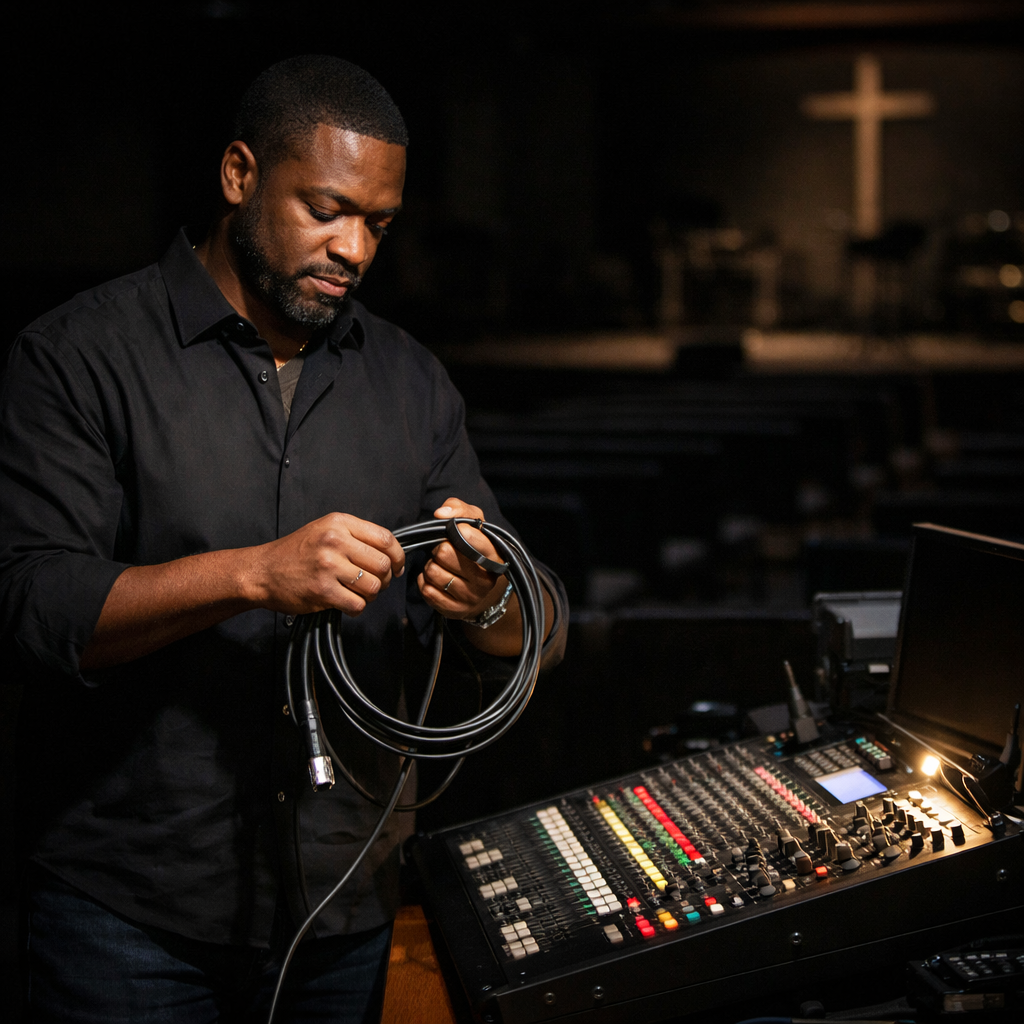
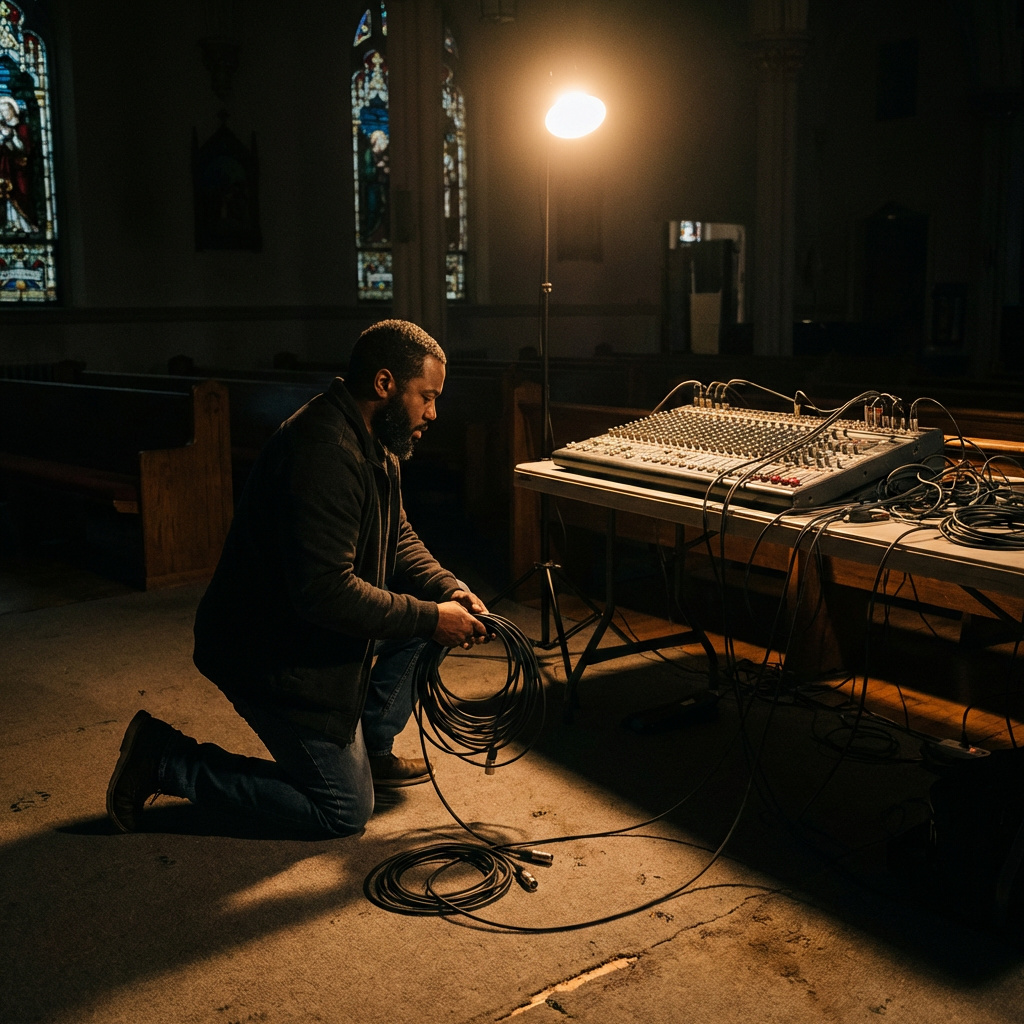
The sanctuary was completely dark, save for the single work light illuminating the soundboard. It was 10:30 PM on a Thursday, and Marcus was meticulously coiling XLR cables, just as he had done every week for the past eight years. At thirty-two, Marcus was the quintessential “church guy.” He was the volunteer media director, a youth group leader, and the guy who unlocked the doors on Sunday mornings.

But as the heavy cables looped around his arm, a profound, suffocating emptiness settled over his chest. He was exhausted. Not just physically, but spiritually bankrupt.
Marcus sat down in the back pew, the silence of the empty church ringing in his ears. He had given his twenties to this building. He had missed family dinners, skipped vacations, and sacrificed his weekends, all under the banner of “serving the Kingdom.” Yet, as he sat there, he realized a terrifying truth: he hadn’t heard the voice of God in months.
Lately, the things that used to inspire him had become a source of deep cynicism. Earlier that week, a staff meeting had devolved into a heated, hour-long argument over the budget for the new stage lighting, while the community food pantry’s funding was quietly slashed. He watched as people jockeyed for solos on the worship team, and he listened to sermons that felt more like motivational speeches designed to boost attendance than messages meant to transform souls. The machinery of the church had overshadowed the majesty of Christ, and Marcus felt like nothing more than a cog keeping the wheels turning.
“God, I’m stuck,” Marcus whispered into the empty room. “I’m doing all this for You, but I don’t even know You anymore.”
The following Sunday, Marcus stood at his post behind the soundboard. The music swelled, the lights swept across the room, and hundreds of hands raised in worship. Marcus felt absolutely nothing. He was too busy worrying about the livestream audio mix and the pastor’s microphone battery.
That afternoon, Marcus made a decision that felt almost scandalous: he skipped the Sunday evening leadership huddle. Instead, he drove to a quiet local park, sat on a wooden bench overlooking a small pond, and opened his Bible—not to prepare a youth lesson, not to find a scripture for a social media graphic, but just for himself.
He flipped through the pages until he landed on the book of Revelation. His eyes fell on the letter to the church in Ephesus, Revelation 2:2-4.
“I know your deeds, your hard work and your perseverance… You have persevered and have endured hardships for my name, and have not grown weary. Yet I hold this against you: You have forsaken the love you had at first.”
The words struck him like a physical blow. Tears pricked his eyes. I know your deeds. God saw the coiled cables, the late nights, the youth retreats. But the diagnosis was painfully accurate: he had forsaken his first love. He had fallen in love with the work of the Lord, and in the process, he had lost the Lord of the work.
Marcus turned to the Gospel of Luke, chapter 10, reading the familiar story of Mary and Martha. Martha was distracted by all the preparations that had to be made, while Mary simply sat at the Lord’s feet listening to what he said.
“Martha, Martha,” the Lord answered, “you are worried and upset about many things, but few things are needed—or indeed only one. Mary has chosen what is better, and it will not be taken away from her.” (Luke 10:41-42).
For years, Marcus had worn his “Martha” status as a badge of honor. He thought his exhaustion was proof of his holiness. But Jesus wasn’t asking for his burnout; He was asking for his presence. The disillusionment Marcus was feeling with the church wasn’t just about the church’s flaws—it was a symptom of his own spiritual malnutrition. He was trying to pour from an empty cup.
He realized that the only way to grow and learn from this season was to embrace the painful process of pruning. He turned to John 15:2: “He cuts off every branch in me that bears no fruit, while every branch that does bear fruit he prunes so that it will be even more fruitful.”
If he wanted to bear real spiritual fruit, he had to let God prune away the excess—even the “good” things that were choking out the “best” things.
The next evening, Marcus sat in his pastor’s office. His heart pounded, but his resolve was firm.
“Pastor, I need to step down from the media team and the youth ministry for the next six months,” Marcus said, his voice steady.
The pastor looked surprised, then concerned. “Marcus, you’re the backbone of our Sunday mornings. Did someone offend you? Is it the new lighting budget?”
“No, it’s not that,” Marcus replied, though a part of him knew the church’s culture needed its own reckoning. “It’s me. I’ve spent so much time building the church that I’ve neglected my own foundation. I’m doing a lot of works, but I’ve lost my first love. I need to learn how to just be a son again, instead of an employee.”
It was a difficult transition. The first few Sundays were agonizing. Marcus sat in the congregation, his hands twitching with the urge to run to the soundboard when the audio fed back. He noticed the flaws, the politics, and the imperfections of the church more clearly than ever.
But instead of letting it turn him bitter, he used it as a prompt to pray. When he saw pride on the stage, he prayed for humility in his own heart. When he felt frustrated by the superficiality, he dug deeper into his own private study of the Word.
Without the heavy burden of ministry, Marcus found his mornings opening up. He started reading the Psalms, letting the raw, unfiltered emotions of David wash over him. He spent time in silence, practicing Psalm 46:10: “Be still, and know that I am God.”
Months passed. The church survived without him running the soundboard—someone else stepped up, just as they always do. But more importantly, Marcus survived. The bitterness that had been calcifying in his heart began to soften. He realized that the church is made up of flawed, broken people, and that its systems will always be imperfect. But his faith was no longer tethered to the machinery of the ministry; it was anchored directly to Christ.
Marcus eventually returned to serving, but this time, it was different. He only took on one role, setting strict boundaries around his time. He had learned the hardest, most beautiful lesson of his faith journey: God didn’t need his hustle. God just wanted his heart.